


A V90 SD card does one thing that lower-rated cards cannot: it guarantees a minimum sustained write speed of 90MB/s, no matter what your camera throws at it. That number is not a peak or a best-case scenario – it is a floor. And for anyone shooting high-bitrate 4K, 6K, or 8K video, that floor is exactly what keeps recordings from dropping frames or stopping mid-clip.
This guide covers everything you need to know about V90 memory cards – what the rating actually means, which cameras require it, how the V90 compares to V60, and which Lexar V90 card fits your specific shooting situation.
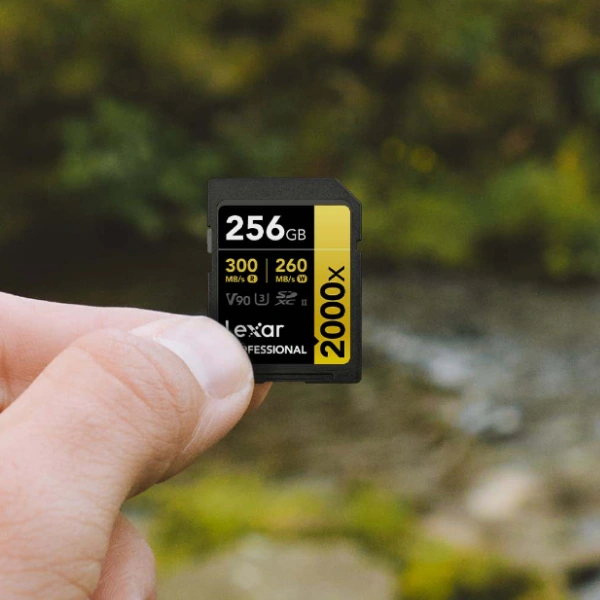
What Does V90 Mean on an SD Card?
The “V” in V90 stands for Video Speed Class, a rating system defined by the SD Association specifically to address sustained video recording performance. Unlike read speed claims on packaging – which describe how fast data transfers to a computer – the Video Speed Class rating governs how consistently a card writes data while your camera is actively recording.
V90 is the highest tier in the Video Speed Class system. The classification ladder looks like this:
- V6 – Minimum 6MB/s sustained write: Basic video recording at 720p or lower bitrates
- V10 – Minimum 10MB/s sustained write: Full HD video and basic 4K capture
- V30 – Minimum 30MB/s sustained write: Standard 4K recording and high-resolution photography
- V60 – Minimum 60MB/s sustained write: High-bitrate 4K and entry-level 6K workflows
- V90 – Minimum 90MB/s sustained write: 8K video, high-bitrate RAW recording, and multi-stream capture
That sustained write guarantee matters more than any headline speed number. A card advertising 280MB/s write speeds without a V90 rating is not obligated to maintain that speed continuously. A V90-rated card is – making it the reliable choice for long recording runs and large RAW files.
Which Cameras Actually Require a V90 SD Card?
Not every camera pushes data fast enough to need V90. The cameras that do tend to fall into one of three categories: high-resolution mirrorless systems shooting in-camera RAW video, cinema-grade cameras recording at elevated bitrates, and stills cameras capturing extended bursts in uncompressed formats.
The table below covers common camera models and their V90 requirements based on manufacturer-published specifications:
| Camera | Recording Format | Max Bitrate | V90 Required? |
|---|---|---|---|
| Sony A1 | 8K XAVC HS, 4K 120p | Up to 600Mbps | Yes – Sony recommends V90 for 8K and high-frame-rate 4K |
| Sony A7R V | 4K oversampled, 61MP RAW bursts | Up to 200Mbps | Yes – V90 recommended for continuous RAW burst |
| Nikon Z9 | 8K RAW (internal), 4K 120p | Up to 570Mbps | Yes – Nikon specifies V90 for 8K RAW recording |
| Nikon Z8 | 8K RAW, 4K 120p | Up to 500Mbps | Yes – V90 required for RAW video modes |
| Canon EOS R5 Mark II | 8K RAW, 4K 60p Cinema RAW Light | Up to 2600Mbps (internal RAW) | Yes – Canon specifies V90 UHS-II for RAW video |
| Canon EOS R3 | 6K RAW, 4K 60p | Up to 4000Mbps (RAW burst) | Yes – V90 UHS-II required for RAW modes |
| Fujifilm GFX 100S II | 4K 30p, 8K timelapse | Up to 400Mbps | Recommended – V90 for high-bitrate 4K |
| Fujifilm X-H2S | 6.2K ProRes RAW (external), 4K 120p | Up to 720Mbps | Yes – V90 required for high-frame-rate 4K recording |
| Panasonic Lumix S5 IIX | 4K 60p All-I, C4K 60p | Up to 200Mbps | Recommended – V90 for All-Intra recording modes |
If your camera is not listed here, check its manual or the manufacturer’s SD card compatibility page. Camera makers publish recommended speed class ratings for each recording mode – and these specifications should be your primary reference, not general guidelines.
V90 vs V60: When Does the Difference Actually Matter?
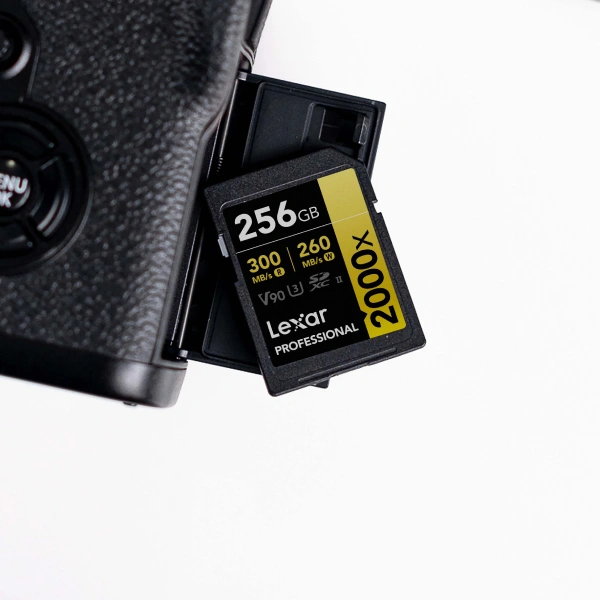
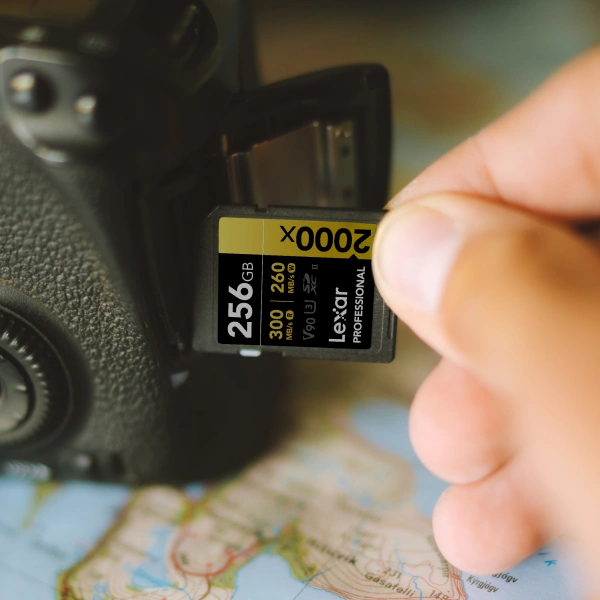
The gap between V60 and V90 on paper is 30MB/s. In practice, that gap shows up at very specific moments: when your camera’s buffer fills during a long burst, when you’re recording at an All-Intra codec with no compression, or when you’re shooting a video format that generates data faster than 60MB/s continuously.
Here’s a breakdown of where each rating performs well – and where V60 reaches its ceiling. You can find more detail on the V60 vs V90 comparison page.
- Standard 4K at 30fps (H.264 or H.265, 100-150Mbps): V60 handles this without issue. Data rates top out around 18MB/s, well within V60’s 60MB/s floor.
- 4K 60p All-Intra or 4K 120p compressed: Data rates climb to 100-200MB/s peak. V90 provides the headroom that V60 may not sustain reliably.
- 6K or 8K RAW video: These formats push data rates above 300MB/s in some cameras. V90 is the only SD classification that can support these workflows.
- High-speed burst photography at 20fps+ in RAW: Buffer clearing speed depends on sustained write performance. V90 clears buffers meaningfully faster than V60.
- Multi-angle or backup recording to two SD slots simultaneously: Each slot bears the full write load. V90 in both slots is safer under this workflow.
If you are primarily shooting 4K at moderate bitrates with a consumer or prosumer camera, V60 is likely sufficient. The moment your camera manual specifies V90, or you are recording at formats listed in the table above, a V60 card introduces risk that V90 removes.
GOLD Series vs. SILVER Series: Choosing the Right Lexar V90 Card
Lexar offers two distinct V90 SD card lines. Both carry the V90 rating, but they serve different users with different priorities. Understanding where each card fits prevents overspending on performance you don’t use – or underspending on a card that holds back your camera.
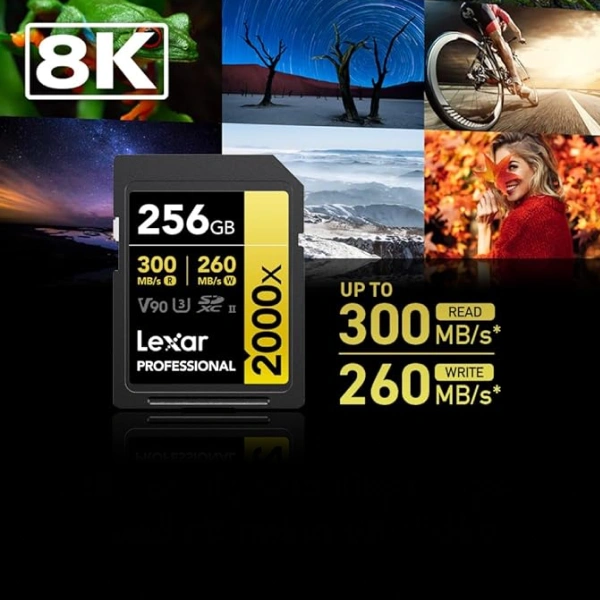
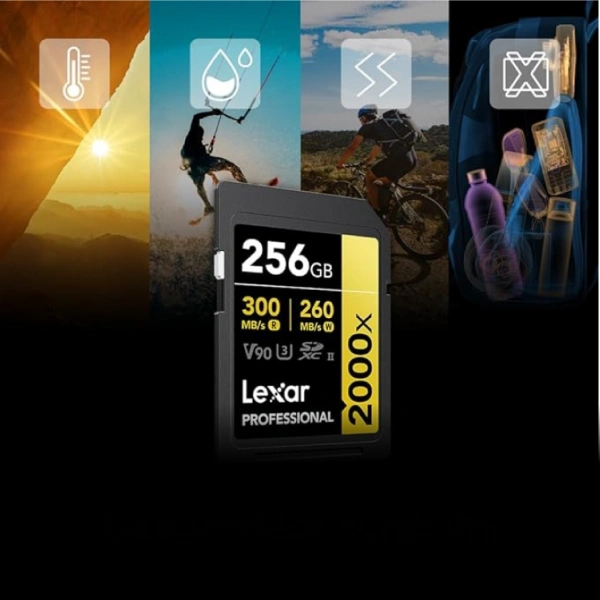
Lexar® Professional 2000x SDHC™/SDXC™ UHS-II Card GOLD Series
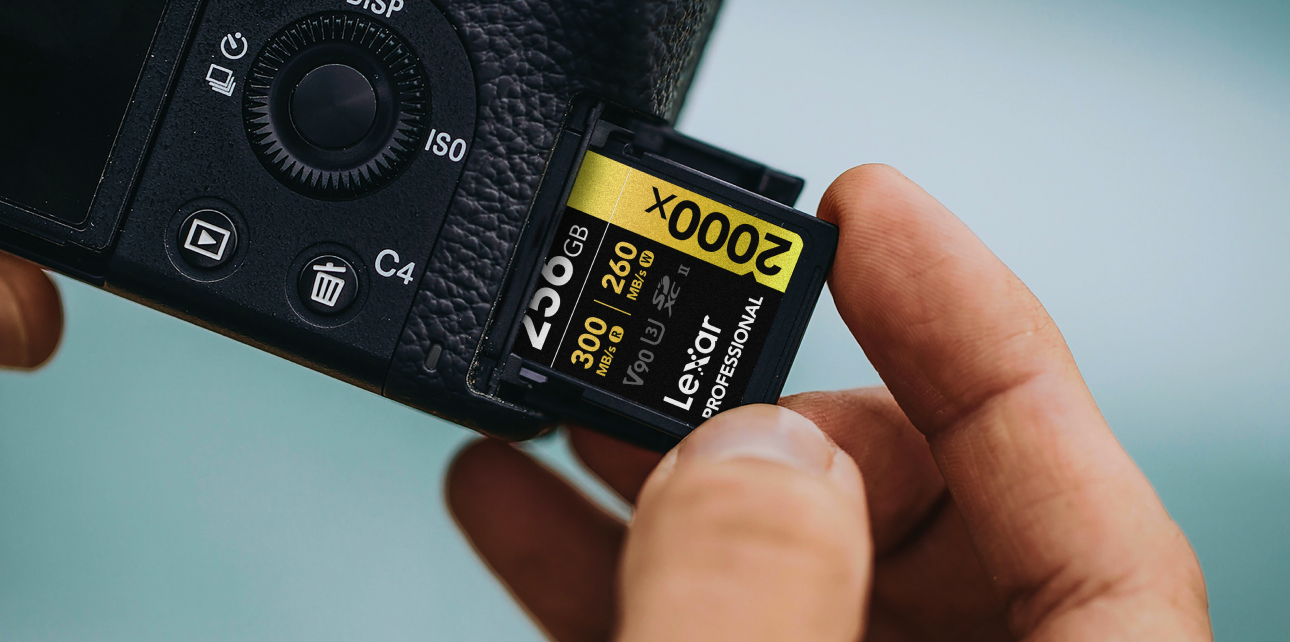
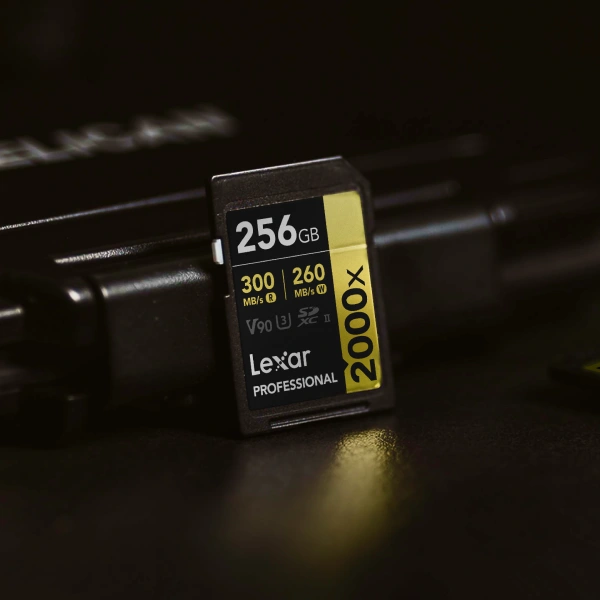
The Lexar® Professional 2000x SDHC™/SDXC™ UHS-II Card GOLD Series is built for the highest demands in professional photography and video production. Key specifications:
- Interface: UHS-II (dual row of pins)
- Speed Class: V90, UHS Speed Class 3 (U3)
- Read speed: Up to 300MB/s
- Write speed: Up to 260MB/s
- Capacities: 64GB, 128GB, 256GB, 512GB
- Durability: Temperature-proof (operating range 0°C to 70°C), shockproof (200G), vibration-proof (IEC 60512-6-4), and X-ray-proof (ISO 7816-1)
- Backwards compatible with UHS-I devices
- Warranty: Limited lifetime
The GOLD Series is the right choice when you need maximum sustained write performance for 8K RAW video, extended burst sessions, or any recording mode where your camera’s manual specifically calls for UHS-II with V90. The 300MB/s read speed also accelerates post-production transfers significantly – a 128GB card of 8K footage moves to your workstation in a fraction of the time it would with slower cards, provided you pair it with a UHS-II compatible card reader.
Lexar® Professional 1066x SDXC™ UHS-I Card SILVER Series
The Lexar® Professional 1066x SDXC™ UHS-I Card SILVER Series delivers V90-class sustained write performance through a UHS-I interface. Key specifications:
- Interface: UHS-I (single row of pins)
- Speed Class: V90, UHS Speed Class 3 (U3)
- Read speed: Up to 160MB/s
- Write speed: Up to 120MB/s
- Capacities: 64GB, 128GB, 256GB, 512GB, 1TB
- Durability: Temperature-proof, shockproof, vibration-proof, and X-ray-proof
- Warranty: Limited lifetime
The SILVER Series covers cameras that have a UHS-I SD slot but still require V90 sustained write speeds for their higher-end recording modes. Because UHS-I is physically limited in interface throughput, the card’s maximum read and write speeds are lower than the GOLD Series – but the V90 minimum sustained write guarantee still applies. This matters for cameras that write at sustained rates between 90MB/s and 120MB/s, particularly high-resolution stills cameras capturing RAW bursts.
GOLD vs SILVER: How to Decide
| Scenario | Recommended Card |
|---|---|
| Camera has UHS-II SD slot and shoots 8K RAW video | GOLD Series (2000x) |
| Camera has UHS-II SD slot and shoots 4K/6K RAW bursts | GOLD Series (2000x) |
| Camera has UHS-I SD slot but requires V90 write performance | SILVER Series (1066x) |
| Fastest possible file transfer to computer (post-production speed) | GOLD Series (2000x) with UHS-II reader |
| High-capacity shooting at lower budget without sacrificing V90 floor | SILVER Series (1066x) |
The key question: does your camera have a UHS-II slot? Check the camera body for a second row of pins in the SD card slot. If it does, and if you are using the camera’s fastest recording modes, the GOLD Series unlocks the full interface speed. If it has a UHS-I slot, the SILVER Series delivers V90 write performance without paying for UHS-II throughput your camera cannot use.
Sustained Write Speed Benchmarks: What V90 Looks Like Under Load
Peak write speeds make for impressive packaging copy. Sustained write speeds tell the real story when you’re 45 minutes into a 4K 60p interview or running back-to-back burst sequences at a fast-moving event.
The SD Association’s V90 standard requires that cards maintain at least 90MB/s write speed continuously during recording. The Lexar® Professional 2000x SDHC™/SDXC™ UHS-II Card GOLD Series is rated for write speeds up to 260MB/s – providing substantial headroom above the 90MB/s minimum for cameras that can use it.
To put that in perspective with real recording scenarios:
- 8K XAVC HS at 200Mbps (25MB/s effective): Well within V90 floor – sustained recording without interruption
- 4K 120p All-Intra at 800Mbps (~100MB/s effective): Requires V90 minimum – the GOLD Series handles this with significant margin
- RAW burst at 20fps with 45MP sensor (~150MB/s sustained): Exceeds V60 reliably only with V90 – GOLD Series absorbs this without buffer stall
- ProRes RAW internal at ~1000Mbps (~125MB/s effective): Requires V90 minimum – SILVER Series at 120MB/s write approaches its ceiling here; GOLD Series remains well within range
These scenarios use bitrate-to-byte conversions (dividing Mbps by 8 for MB/s) aligned with how SD card write speeds are reported. Camera-reported bitrates are in megabits; card speeds are in megabytes.
Capacity Guide: How Much Storage Do You Actually Need?
V90 SD cards from Lexar are available in 64GB, 128GB, 256GB, and 512GB (GOLD Series), with the SILVER Series additionally offering 1TB. The right capacity depends on your recording format, session length, and backup habits.
- 64GB: A reasonable starting point for stills photographers or videographers shooting compressed 4K. At 200Mbps, 64GB holds roughly 43 minutes of footage.
- 128GB: The most popular choice for professional videographers. At 200Mbps, roughly 87 minutes of 4K; at 100Mbps, nearly 3 hours of continuous recording.
- 256GB: For extended shoots, multi-camera productions, or 8K workflows where file sizes scale quickly. Pairs well with the GOLD Series for all-day 4K coverage.
- 512GB: Documentary work, event coverage, or situations where card swaps are not practical. At 8K with lower compression, 512GB provides several hours of reliable headroom.
- 1TB (SILVER Series): Maximum storage for demanding use cases where capacity and V90 write performance matter more than peak interface speed.
One useful calculation: multiply your camera’s video bitrate (in Mbps) by your anticipated shooting time in minutes, divide by 8 to convert to MB, then divide by 1,024 for GB. That gives you a baseline estimate before factoring in RAW stills captured alongside video.
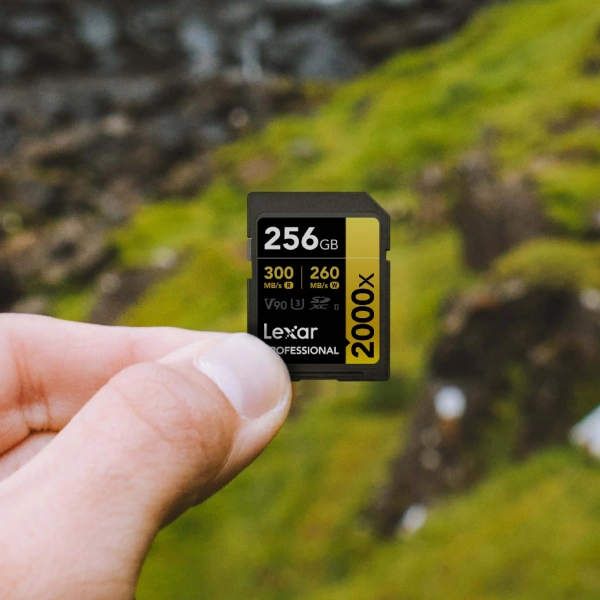
Getting the Most from Your V90 SD Card
A V90 card performs to its rating when used correctly. A few practices protect that performance:
- Use a UHS-II card reader for GOLD Series transfers: The 300MB/s read speed of the Lexar® Professional 2000x SDHC™/SDXC™ UHS-II Card GOLD Series requires a UHS-II compatible reader to reach its potential. A UHS-I reader bottlenecks transfer speeds to approximately 104MB/s regardless of the card’s capability.
- Format in-camera, not on computer: Formatting inside your camera writes the file system your specific device expects, reducing the risk of write errors and maintaining optimal performance over time.
- Avoid filling cards to capacity: Most storage media, including SD cards, slows slightly as available space decreases. Staying below 90% capacity during active shooting preserves write headroom.
- Store in a dry, temperature-controlled environment: The Lexar GOLD and SILVER Series are rated for storage between -25°C and 85°C (-13°F to 185°F), but keeping cards away from extreme heat or humidity extends their reliable lifespan.
- Back up before formatting: No card is immune to physical damage. Transfer footage to at least two locations before clearing a card for reuse.
For a broader look at the best SD cards for 4K video recording and how V90 fits into a professional video workflow, that guide covers format-specific recommendations in detail. If you’re considering alternatives like CFexpress cards for cameras that support both slot types, that guide explains the trade-offs between formats.
Frequently Asked Questions About V90 SD Cards
What is a V90 SD card?
A V90 SD card is a memory card rated Video Speed Class 90 by the SD Association, guaranteeing a minimum sustained write speed of 90 MB/s during continuous recording. V90 is the highest tier in the Video Speed Class system, positioned above V60 (60 MB/s) and V30 (30 MB/s). These cards are built for cameras recording 8K video, high-bitrate 4K and 6K RAW formats, and extended burst photography at high frame rates. Most V90 SD cards use a UHS-II interface, with top options like the Lexar Professional 2000x SDHC/SDXC UHS-II Card GOLD Series delivering read speeds up to 300 MB/s and write speeds up to 260 MB/s — well beyond the V90 minimum.
Do I need a V90 SD card for 4K video?
It depends on the bitrate of your 4K recording mode. Standard 4K at 30fps with H.264 or H.265 compression typically generates data at 10–25 MB/s, which a V30 or V60 card handles without issue. However, 4K at 60fps or 120fps in All-Intra codecs, or 4K RAW formats in high-end mirrorless cameras, can push sustained write requirements above 60 MB/s — into territory where only a V90 SD card can prevent dropped frames and buffer overflows. Cameras like the Sony A7S III, Canon EOS R5, and Nikon Z8 all require V90 speeds when shooting their most demanding 4K formats. Check your camera manual’s recommended speed class for each recording mode to determine what you actually need.
What is the difference between V90 and V60 SD cards?
The core difference is minimum sustained write speed: a V60 SD card guarantees at least 60 MB/s, while a V90 SD card guarantees 90 MB/s — a 50% increase. In real-world shooting, this gap matters most during high-bitrate 4K, 6K, and 8K recording, burst photography in RAW format, and any workflow where the camera generates data faster than 60 MB/s. V90 cards also typically feature faster maximum speeds — the Lexar Professional 2000x reaches 260 MB/s write versus the 120–130 MB/s common in V60 cards — which significantly reduces file transfer time during post-production. For a detailed breakdown, see the full V60 vs V90 SD card comparison.
Which cameras require a V90 SD card?
Several professional and enthusiast cameras require or strongly recommend a V90 SD card for their highest-quality recording modes:
- Sony A7S III / FX3 / FX30 — Required for 4K 120fps S&Q mode (recording at 600 Mbps)
- Canon EOS R5 / R5 C — Required for 8K RAW and high-frame-rate 4K internal recording
- Nikon Z8 / Z9 — Recommended for N-RAW and ProRes RAW when using the SD card slot
- Panasonic S1H / GH7 — Required for high-bitrate All-Intra 4K and 6K modes
- Sony A1 — Recommended for 50MP RAW bursts at 30fps and 8K video capture
Always check your camera manual’s “recommended media” section. Many cameras accept slower cards for basic recording but require V90 specifically for their top-tier video and burst modes.
What is the difference between UHS-II and V90?
UHS-II and V90 measure different things. UHS-II refers to the interface standard — the physical connection and data bus between the card and camera slot. It defines the maximum theoretical throughput the card and device can achieve together. V90 refers to the minimum sustained write speed guarantee during continuous recording. A card can be UHS-II and V90, like the Lexar Professional 2000x SDHC/SDXC UHS-II Card GOLD Series, or UHS-I and V90, like the Lexar Professional 1066x SDXC UHS-I Card SILVER Series. Which combination you need depends on your camera’s slot type and the recording bitrate of your preferred shooting modes.
Can a V90 SD card improve photo burst performance?
Yes. During high-speed burst shooting, your camera writes RAW files to the card as fast as the card’s sustained write speed allows. A V90 SD card — particularly a UHS-II model like the Lexar Professional 2000x — clears the camera’s buffer more quickly than a V30 or V60 card, allowing longer uninterrupted burst sequences before the camera slows down to finish writing. This matters most for sports, wildlife, and event photographers shooting 20fps or faster in RAW. Cameras like the Sony A1 (50MP at 30fps) and Canon EOS R3 (24MP at 30fps) can overwhelm a V60 card during sustained bursts, making V90 the difference between capturing the decisive moment and waiting on a full buffer.
Do V90 SD cards work in all cameras?
V90 SD cards are physically compatible with any device that has a standard SD or SDXC card slot. However, you will only achieve full V90 speeds in cameras with UHS-II compatible slots. In a UHS-I only camera, a UHS-II V90 card still functions correctly — it is fully backwards compatible — but speeds will be limited to UHS-I maximums (approximately 104 MB/s read). UHS-I V90 cards like the Lexar Professional 1066x work in any SD-compatible device without interface restrictions. Before investing in a UHS-II V90 card, confirm your camera supports UHS-II — this is typically listed in the spec sheet under “card slot” or “compatible media.”
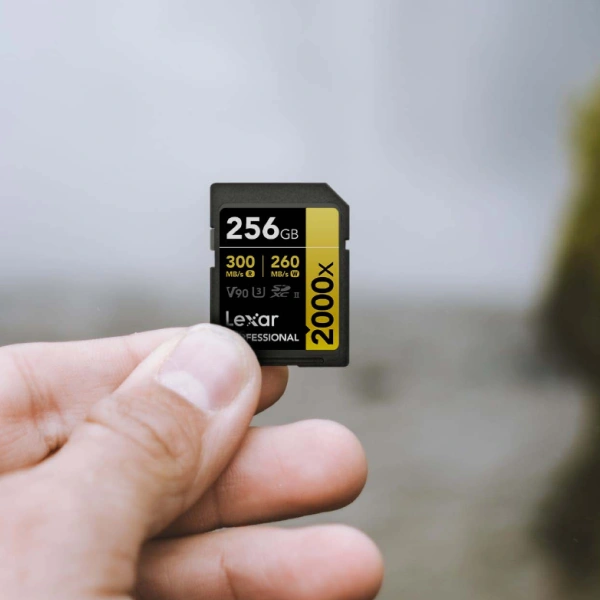
The Right V90 Card for Your Camera and Workflow
V90 memory cards cover the performance tier that high-resolution cameras require. Whether you’re recording 8K RAW on a mirrorless system, running extended bursts with a high-megapixel stills camera, or shooting 4K 120p in All-Intra codecs, the V90 sustained write guarantee removes storage as the limiting factor in your recording chain.
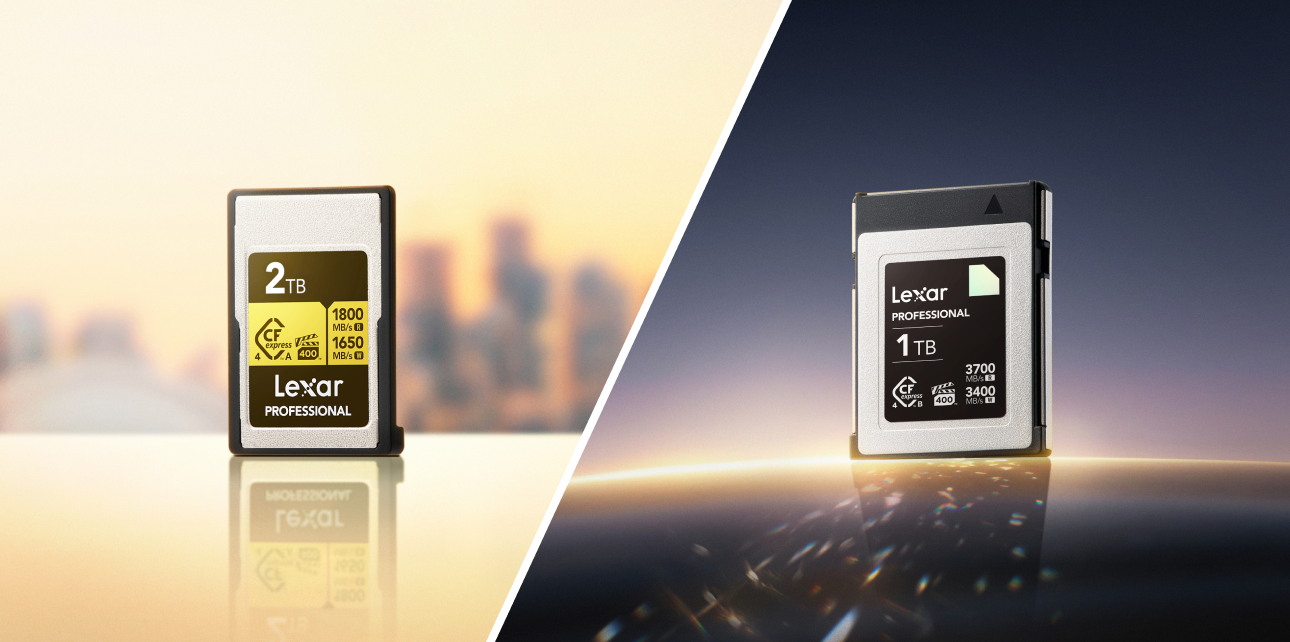
Two Lexar V90 options cover most scenarios. The Lexar® Professional 2000x SDHC™/SDXC™ UHS-II Card GOLD Series – with read speeds up to 300MB/s and write speeds up to 260MB/s – is the choice for cameras with UHS-II slots and demanding professional workflows. The Lexar® Professional 1066x SDXC™ UHS-I Card SILVER Series delivers V90-rated sustained write performance for cameras using UHS-I, with capacities reaching 1TB.
Check your camera’s SD card specification in the manual, match the interface (UHS-I or UHS-II), and select the capacity that fits your longest anticipated shoot. From there, the V90 rating does exactly what it promises – keeps your camera recording without interruption, whatever format you’re capturing.
Not sure which SD card tier is right for your setup? The V60 vs V90 comparison guide breaks down the decision for every recording scenario, and the best SD cards for 4K video guide covers format-specific recommendations from action cameras through cinema-grade systems.
When your reputation and livelihood depend on capturing perfect footage, choose the brand that professionals have relied on for decades. Explore our complete range of SD memory cards and find the perfect solution for your creative workflow.