


Most people think of storage as the place where files go. In professional post-production, scratch disks serve a fundamentally different purpose. They’re the temporary workspace where your creative applications perform the intensive operations that make modern editing possible.
When you scrub through a 4K timeline in Premiere Pro, the application isn’t just reading video files — it’s generating preview frames, caching decoded footage, storing temporary render files, and maintaining complex data structures that track every edit, effect, and transition. All of this happens on your scratch disk, and the speed of these operations directly impacts your creative flow.
Why Traditional Storage Falls Short
Traditional hard disk drives (HDDs) were designed for sequential data access — reading large files from beginning to end. But scratch disk operations are fundamentally different. They involve thousands of small, random read and write operations happening simultaneously across multiple files and applications.
When a mechanical drive tries to handle scratch disk duties, the read/write heads spend more time seeking between different file locations than actually transferring data. This creates the characteristic “stuttering” experience where timeline playback becomes choppy, effects take forever to render, and the entire interface becomes unresponsive during intensive operations.
Even SATA SSDs, while dramatically better than mechanical drives, face fundamental limitations. The SATA interface was designed for the mechanical drive era and tops out at around 600MB/s theoretical bandwidth. When you’re working with 4K or 8K footage that can generate gigabytes of temporary data per minute, SATA quickly becomes the bottleneck that limits your entire workflow.
The NVMe Advantage for Scratch Operations
Non-volatile memory express (NVMe) is designed from the ground up for the parallel, random-access patterns that define modern computing workloads. Instead of the single command queue that SATA uses, NVMe supports up to 65,535 command queues, each capable of handling 65,536 commands simultaneously.
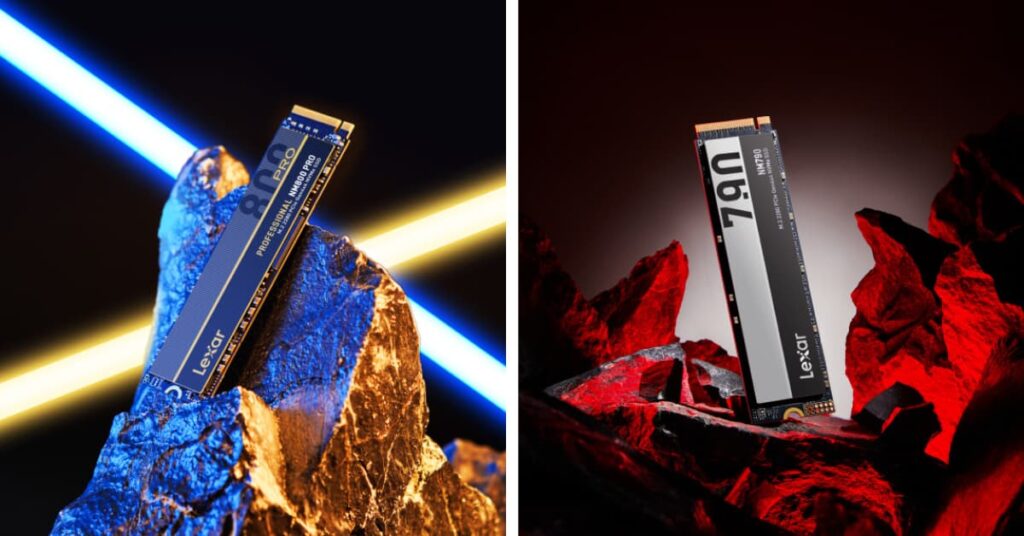
This massive parallelism transforms scratch disk performance. When Premiere Pro needs to cache multiple video streams while After Effects renders a complex composition in the background, NVMe drives like our Lexar® Professional NM800 PRO M.2 2280 NVMe SSD can handle these concurrent operations without the performance degradation that would cripple SATA drives.
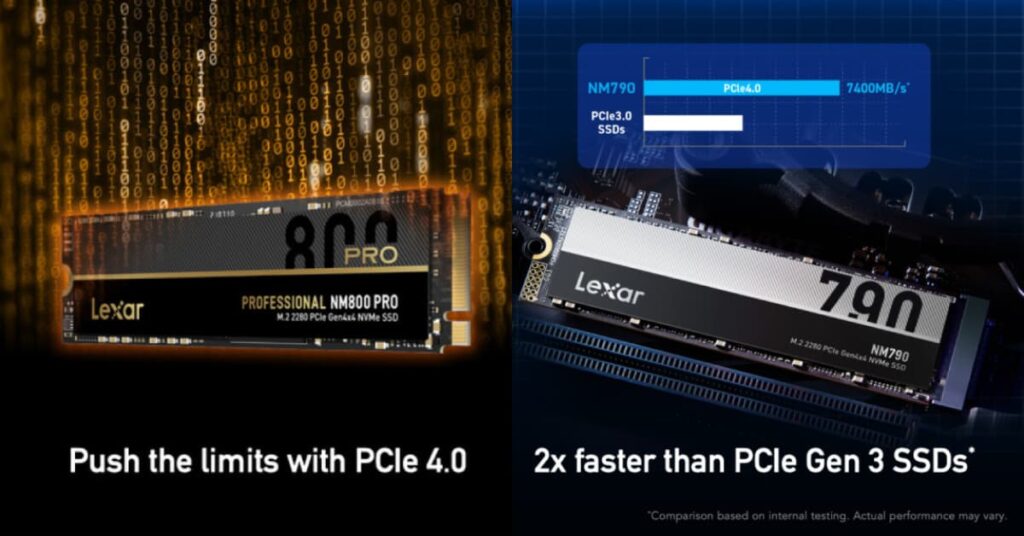
The direct PCIe connection eliminates the protocol overhead that slows SATA operations. Our Lexar® NM790 M.2 2280 PCIe Gen 4×4 NVMe SSD achieves up to 7400MB/s read and 6500MB/s write speeds – more than 12 times faster than SATA SSDs. This isn’t just about raw speed numbers; it’s about maintaining consistent performance under the complex, multi-threaded workloads that define professional post-production.
Real-World Impact on Creative Applications
The difference between traditional storage and high-performance NVMe scratch disks becomes immediately apparent in day-to-day creative work. Timeline scrubbing becomes fluid and responsive, allowing editors to make precise cuts and adjustments without waiting for the system to catch up. Effect previews that once required lengthy render times now appear almost instantaneously.
Color grading workflows show particularly dramatic improvements. When working with RAW footage in DaVinci Resolve, every adjustment generates temporary files as the application processes the original data. With fast NVMe scratch storage, colorists can make real-time adjustments while viewing full-quality output, transforming the creative process from a stop-and-wait workflow to a fluid, artistic experience.
Lexar NVMe Solutions: Engineering for Post-Production Excellence
Not all NVMe drives are created equal, especially when it comes to the demanding requirements of professional post-production scratch disk operations. The workloads generated by video editing, color grading, and motion graphics applications place unique stresses on storage systems that require specialized engineering approaches.
The Flagship: Professional NM1090 PRO PCIe 5.0 SSD
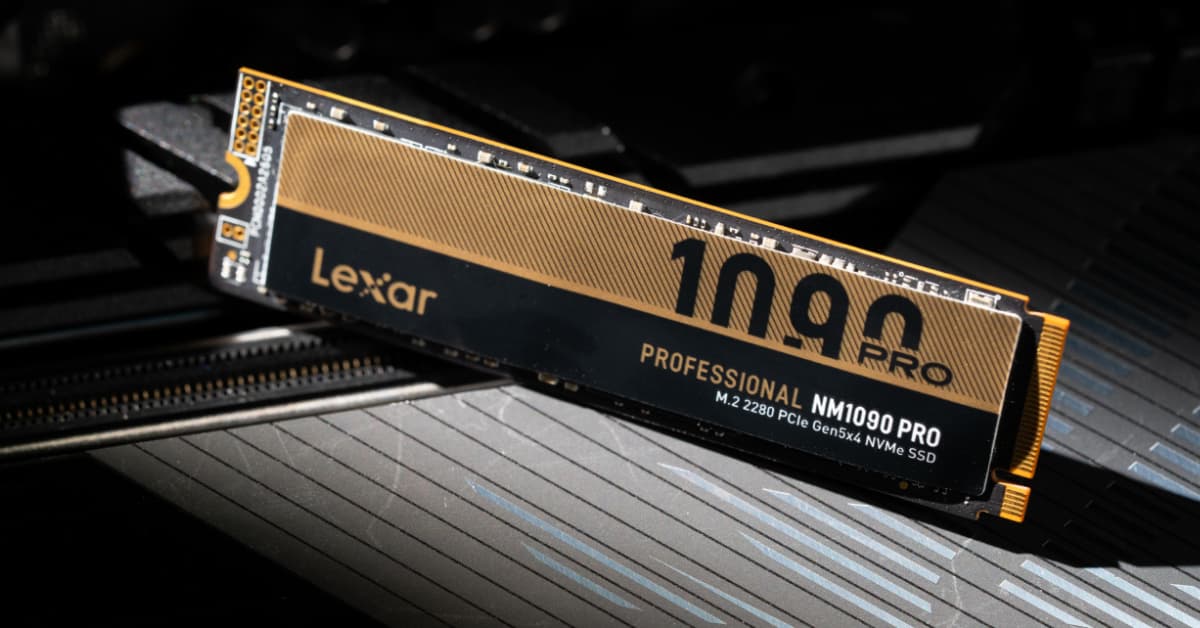
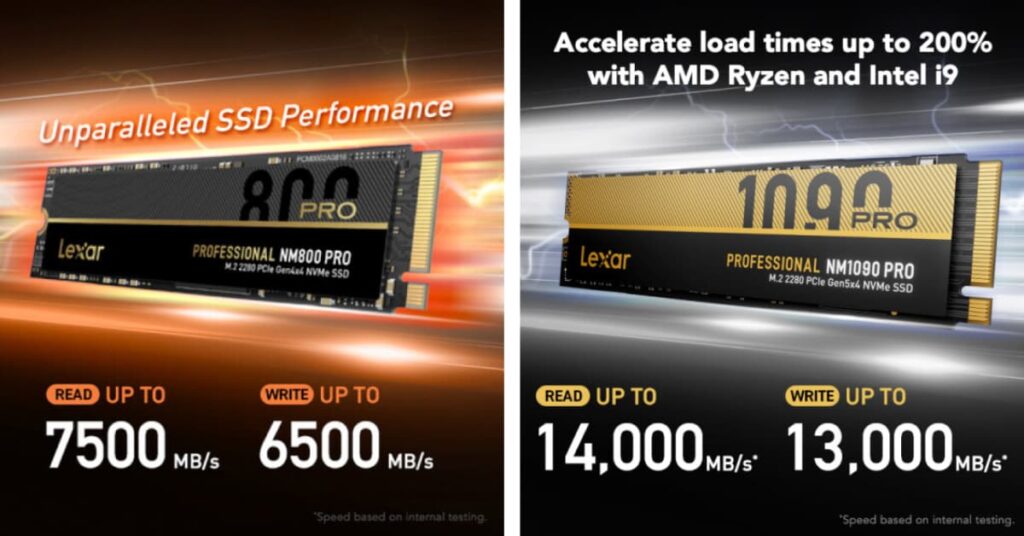
The Lexar® Professional NM1090 PRO PCIe 5.0 SSD represents the pinnacle of scratch disk performance. With sequential read speeds up to 14,000MB/s and write speeds up to 13,000MB/s, it provides the raw bandwidth needed for the most demanding post-production workflows.
What sets this drive apart for scratch disk applications is its advanced 6nm controller technology. This isn’t just about speed — it’s about maintaining consistent performance under sustained workloads. At high performance loads, the NM1090 PRO’s peak temperatures are 36 percent lower compared to competing drives using older 12nm controllers. This thermal efficiency is crucial for scratch disk operations, which often involve hours of continuous high-intensity data transfers.
The drive features both DRAM cache and SLC dynamic cache technologies. The DRAM cache provides ultra-fast access to frequently used data, while the SLC cache accelerates write operations by temporarily storing data in faster single-level cell memory before moving it to the main storage array. For scratch disk applications, this dual-cache architecture ensures that temporary files and frequently accessed data remain available at maximum speed.
Built to leverage Microsoft DirectStorage technology, the NM1090 PRO enables new possibilities for real-time asset streaming and reduced CPU overhead in supported applications. This technology becomes increasingly important as post-production workflows evolve toward higher resolutions and more complex real-time effects processing.
Professional Performance: NM800 PRO M.2 2280 NVMe SSD
For professionals seeking excellent scratch disk performance at a more accessible price point, the Lexar® Professional NM800 PRO M.2 2280 NVMe SSD provides exceptional capabilities with read speeds up to 7500MB/s and write speeds up to 6500MB/s.
This drive leverages a 12nm controller that’s specifically optimized for professional workloads. The controller implements advanced error correction and wear leveling algorithms that ensure reliable operation during the intensive write operations common in scratch disk applications. With 4K random read/write performance up to 1300K/1200K IOPS, it excels at the small-file operations that characterize preview generation and cache management.
The NM800 PRO’s robust construction includes shock and vibration resistance, making it ideal for mobile post-production setups where equipment might face challenging conditions. The drive’s power management features also optimize battery life in laptop configurations while maintaining peak performance when needed.
Available in capacities up to 8TB, the NM800 PRO provides the storage space needed for large-scale projects while maintaining consistent performance across the entire capacity range. This scalability makes it an excellent choice for facilities that need to balance performance requirements with storage capacity needs.
Exceptional Value: NM790 M.2 2280 PCIe Gen 4×4 NVMe SSD
The Lexar® NM790 M.2 2280 PCIe Gen 4×4 NVMe SSD delivers outstanding scratch disk performance at an attractive price point, with read speeds up to 7400MB/s and write speeds up to 6500MB/s. This makes high-performance NVMe scratch disk capabilities accessible to a broader range of post-production professionals.
The drive incorporates Host Memory Buffer (HMB) 3.0 technology, which uses system RAM to accelerate storage operations. This is particularly beneficial for scratch disk applications, where the drive can leverage available system memory to cache frequently accessed temporary files and metadata, reducing access latency and improving overall system responsiveness.
Dynamic SLC cache technology ensures that write operations remain fast even during sustained workloads. As applications generate temporary files and cache data, the drive’s intelligent caching algorithms prioritize performance while maintaining data integrity. This makes the NM790 particularly well-suited for mixed workloads where multiple applications might be accessing the scratch disk simultaneously.
The drive uses DRAM-less architecture but compensates with advanced controller design and intelligent caching strategies. Despite this cost-optimization approach, independent reviews have confirmed that the NM790 maintains competitive performance levels for most professional applications, making it an excellent value choice for scratch disk operations.
Smart Performance: NQ780 M.2 2280 PCIe 4.0 NVMe SSD
For budget-conscious professionals or those building multi-drive systems, the Lexar® NQ780 M.2 2280 PCIe 4.0 NVMe SSD provides solid scratch disk performance with read speeds up to 7000MB/s and write speeds up to 6000MB/s, along with Intelligent Power Control optimized for mobile workstations.
The drive’s single-sided design and power-efficient operation make it ideal for laptop configurations where thermal management and battery life are important considerations. The NQ780 includes the Lexar DiskMaster SSD Management tool, which provides monitoring and optimization capabilities specifically designed to maintain peak performance in demanding applications.
Optimizing Scratch Disk Configuration for Maximum Performance
Simply installing a fast NVMe drive doesn’t automatically optimize your post-production workflow. Proper scratch disk configuration requires understanding how different applications use temporary storage and configuring your system to maximize the advantages that high-performance NVMe storage provides.
Multi-Drive Strategies for Professional Workflows
The most effective post-production systems often employ multiple NVMe drives in specialized configurations. The optimal setup typically involves separating different types of operations across dedicated drives to maximize parallel performance and minimize conflicts between different data streams.
A professional configuration might include the Lexar® Professional NM1090 PRO PCIe 5.0 SSD as the primary scratch disk for preview files, temporary renders, and cache operations. The extreme performance of this drive ensures that the most demanding operations — like real-time color grading of 8K RAW footage or complex After Effects compositions ‚ never wait for storage.
The Lexar® Professional NM800 PRO M.2 2280 NVMe SSD might serve as a secondary scratch disk for overflow operations and project files, while the Lexar® NM790 M.2 2280 PCIe Gen 4×4 NVMe SSD could handle media cache and less time-sensitive temporary file operations. This distributed approach ensures that no single drive becomes a bottleneck while providing redundancy and workload distribution.
Application-Specific Optimization Techniques
Different creative applications have unique scratch disk requirements that benefit from specific optimization approaches. Understanding these requirements allows you to configure your Lexar NVMe drives for maximum effectiveness in your particular workflow.
Adobe Premiere Pro generates preview files, audio conforming data, and media cache files that benefit from fast sequential write performance. Configuring Premiere Pro to use the Lexar® Professional NM1090 PRO PCIe 5.0 SSD for media cache and preview files while directing project files to a separate drive optimizes both performance and organization.
DaVinci Resolve’s cache operations involve both large sequential transfers for RAW debayering and small random operations for thumbnail and waveform generation. The mixed workload characteristics make Resolve particularly well-suited to NVMe drives with sophisticated caching algorithms like those found in our professional NVMe lineup.
After Effects places unique demands on scratch storage through its memory-intensive compositions and complex caching algorithms. The application benefits significantly from drives with large DRAM caches and fast random access performance, making the Lexar® Professional NM800 PRO M.2 2280 NVMe SSD with its advanced controller architecture an excellent choice for AE-heavy workflows.
System Integration and Thermal Management
High-performance NVMe drives generate significant heat during sustained operations, and thermal throttling can dramatically impact scratch disk performance. Proper thermal management becomes crucial when pushing these drives to their limits in professional post-production environments.
The Lexar® Professional NM1090 PRO PCIe 5.0 SSD includes advanced thermal management features that maintain consistent performance even during extended high-intensity operations. The drive’s 6nm controller operates at significantly lower temperatures than older designs, reducing the likelihood of thermal throttling during marathon editing sessions.
For systems requiring maximum sustained performance, considering M.2 slot placement and case ventilation becomes important. Slots closer to graphics cards or in poorly ventilated areas can lead to thermal issues that impact performance. Some users benefit from aftermarket M.2 heatsinks or systems with dedicated M.2 cooling solutions.
The power requirements of high-performance NVMe drives also affect system design. Professional workstations should include adequate power supplies and appropriate PCIe slot allocation to ensure that multiple high-performance drives can operate simultaneously without power or bandwidth limitations.

Real-World Performance: Case Studies and Professional Applications
Understanding the theoretical advantages of NVMe scratch disks becomes most meaningful when examining actual professional workflows and the tangible improvements that high-performance storage delivers in real-world scenarios.
Feature Film Post-Production: 8K RAW Workflows
Modern feature film production increasingly relies on high-resolution cameras shooting in RAW formats that generate enormous amounts of data. A typical day of RED 8K shooting can produce 2TB or more of footage, creating significant challenges for post-production workflows using traditional storage solutions.
Professional editorial facilities have found that upgrading to high-performance NVMe scratch drives transforms the editing experience. Timeline playback becomes fluid even with multiple streams of 8K RAW footage, allowing editors to make precise cuts and adjustments in real-time without waiting for storage operations.
The Lexar® Professional NM1090 PRO PCIe 5.0 SSD with its exceptional 14,000MB/s read and 13,000MB/s write speeds enables color grading sessions to work with live footage rather than requiring preview file generation. This capability dramatically accelerates the creative process by eliminating the traditional workflow delays associated with proxy generation and preview rendering.
Post-production supervisors report that facilities implementing high-performance NVMe scratch disk configurations can reduce overall project timelines by 20 percent to 30 percent, primarily due to improved editor and colorist productivity when storage operations no longer interrupt creative flow.
Documentary Production: Mobile Workflows and Field Editing
Documentary filmmakers often require portable editing capabilities for daily footage review and rough cut assembly, especially when working in remote locations where traditional post-production infrastructure isn’t available. Mobile workstations equipped with high-performance NVMe scratch storage enable full-quality editing in field conditions where internet connectivity and power management are critical constraints.
The Lexar® Professional NM800 PRO M.2 2280 NVMe SSD provides an excellent balance of performance and power efficiency for mobile editing applications. Its advanced controller technology optimizes power consumption while maintaining consistent high performance, extending laptop battery life during extended editing sessions.
Field editors particularly benefit from the ability to review and make initial cuts of 4K footage without waiting for proxy media generation. This immediate feedback capability improves shooting decisions and reduces overall project timeline by eliminating the traditional gap between acquisition and post-production review.
The robust construction and reliable operation of professional NVMe drives make them well-suited for the challenging conditions of remote field work, maintaining consistent performance despite transportation stress and varying environmental conditions.
Commercial Production: High-Volume Turnaround
Commercial production facilities often handle multiple simultaneous projects with tight deadlines, requiring scratch disk solutions that maintain consistent performance across varied workloads. High-performance NVMe configurations provide the performance density needed for these demanding operational requirements.
Multi-drive configurations using drives like the Lexar® NM790 M.2 2280 PCIe Gen 4×4 NVMe SSD enable individual editors to work on complex motion graphics compositions without impacting other workstations sharing network resources. The fast local scratch storage reduces reliance on network-based shared storage for temporary operations, improving both individual workstation performance and overall network efficiency.
Production facilities implementing high-performance NVMe scratch disk architectures typically report significant reductions in project turnaround times, primarily due to faster preview generation, more responsive editing interfaces, and reduced render times for complex compositions.
The improved workflow efficiency directly translates to increased facility capacity and improved client satisfaction through faster delivery times and the ability to accommodate more complex creative requirements within standard project budgets.
Live Production: Real-Time Graphics and Instant Replay
Sports broadcast and live event production require instant access to recorded content for replay generation, graphics loading, and real-time content creation. Traditional storage solutions can create delays that impact live production quality and viewer experience, making high-performance scratch disk implementation critical for professional broadcast operations.
Implementing Lexar® Professional NM1090 PRO PCIe 5.0 SSD scratch storage in broadcast environments eliminates traditional playback delays and enables new production capabilities. Instant replay systems can access and play back high-resolution footage without buffering delays, providing production teams with the flexibility needed for compelling live coverage.
Graphics operators benefit from the ability to load complex animations and templates instantly, enabling more sophisticated real-time graphics that enhance viewer engagement. The improved storage performance also supports higher-quality recording formats, allowing facilities to archive content in formats suitable for future reuse while maintaining real-time operational requirements.
Live production environments particularly benefit from the consistent performance characteristics of high-end NVMe drives, as any storage-related delays during live broadcasts can have immediate and visible impact on program quality and viewer experience.

Technical Optimization: Advanced Configuration Strategies
Maximizing the post-production benefits of usingLexar NVMe storage as scratch disk solutions requires an understanding of advanced configuration techniques that optimize both hardware and software components for professional workflows.
Multi-Application Coordination
Professional post-production workflows often involve multiple applications running simultaneously — editors might have Premiere Pro, After Effects, Photoshop, and audio applications all active during complex projects. Each application competes for scratch disk resources, and proper configuration ensures optimal resource allocation.
Advanced users configure dedicated scratch disk paths for each application to prevent conflicts and optimize access patterns. The Lexar® Professional NM1090 PRO PCIe 5.0 SSD with its massive parallel processing capabilities can handle multiple simultaneous scratch disk workloads without performance degradation, but proper path management ensures maximum efficiency.
Application priority settings and scratch disk allocation become crucial when multiple demanding processes compete for resources. Configuring primary applications like Premiere Pro to use the fastest available scratch disk while directing background processes to secondary drives optimizes overall system performance.
Memory and Storage Integration
Modern post-production systems benefit from treating high-speed NVMe storage as an extension of system memory rather than traditional storage. The speed differential between DDR4/DDR5 RAM and high-performance NVMe drives like the Lexar® Professional NM1090 PRO PCIe 5.0 SSD has narrowed significantly, enabling new optimization strategies.
Intelligent caching algorithms in creative applications can leverage fast NVMe storage to extend effective system memory beyond physical RAM limitations. This allows systems to handle larger projects and more complex compositions without the traditional memory constraints that limited creative scope.
Virtual memory and paging file configuration becomes particularly important in high-performance systems. Directing system virtual memory to fast NVMe scratch disks ensures that memory overflow operations don’t create system bottlenecks that impact creative applications.
Network Integration and Shared Resources
Professional facilities often integrate local high-performance scratch storage with network-based shared resources. The key is leveraging local NVMe speed for operations that benefit from low latency while using network storage for operations that require shared access or long-term retention.
Automated asset management systems can use fast local scratch storage for active projects while transferring completed work to network storage for archival and collaboration. This hybrid approach maximizes both performance and resource utilization while maintaining proper project management workflows.
Advanced network configurations can also enable shared high-speed scratch resources through technologies like NVMe over Fabrics, though these implementations require specialized infrastructure and expertise to deploy effectively.
Performance Monitoring and Optimization
Maintaining peak scratch disk performance requires ongoing monitoring and optimization. The Lexar DiskMaster SSD Management tool provides comprehensive monitoring and management capabilities that help maintain optimal performance throughout the drive’s lifecycle.
Regular performance monitoring helps identify potential issues before they impact production workflows. Metrics like write amplification, temperature patterns, and IOPS utilization provide insights into system optimization opportunities and potential hardware issues.
Firmware updates and drive optimization become particularly important for drives under heavy professional use. Regular maintenance schedules help ensure that scratch disk performance remains consistent over time and that drives continue operating at peak efficiency.
Future-Proofing Your Post-Production Pipeline
The journey from recognizing scratch disk bottlenecks to implementing solutions that make storage disappear from the workflow entirely represents more than just technical progress. This journey is about removing barriers between creative vision and execution, enabling professionals to focus on storytelling rather than technical limitations.
When colorists can work with live 8K RAW footage instead of compressed proxies, when editors can scrub through complex timelines without rendering previews, when motion graphics artists can iterate in real-time instead of waiting for cache builds, the creative process fundamentally changes.
The Evolution Continues
PCIe 5.0 adoption is accelerating with drives like our Lexar® Professional NM1090 PRO PCIe 5.0 SSD leading the way toward even higher performance standards. DirectStorage and similar technologies promise to further optimize the relationship between applications and storage, reducing CPU overhead and enabling new real-time capabilities.
The integration of artificial intelligence and machine learning into creative applications will likely place new demands on scratch disk performance. AI-powered features like automated scene detection, content-aware editing, and real-time upscaling require storage systems that can handle massive data throughput while maintaining low latency for interactive operations.
Emerging content formats — from high frame rate 8K to volumetric video and extended reality applications – will continue pushing storage performance requirements. The infrastructure decisions made today about scratch disk architecture will determine which facilities can adapt to these evolving demands and which become limited by their storage choices.
Building Sustainable Performance
Professional post-production demands more than just peak performance — it requires sustained, reliable operation under the intense workloads that characterize deadline-driven creative environments. Our NVMe drives are engineered for exactly these conditions, with advanced thermal management, sophisticated error correction, and intelligent wear leveling that ensures consistent performance throughout their operational lifetime.
The Lexar® Professional NM800 PRO M.2 2280 NVMe SSD with its proven reliability in professional environments and the Lexar® NM790 M.2 2280 PCIe Gen 4×4 NVMe SSD with its exceptional performance-per-dollar value provide options for facilities at different scales and budget levels, all backed by our commitment to professional-grade reliability.
Investment in proper scratch disk infrastructure pays dividends not just in immediate productivity improvements but in long-term competitive advantage. Facilities that can deliver faster turnaround times, handle more complex projects, and adapt to evolving technical requirements maintain their position as industry leaders.
Making Informed Decisions
Understanding the technical principles behind NVMe scratch disk performance – from the parallel command queues that enable massive IOPS performance to the thermal management that sustains peak speeds during marathon sessions – empowers professionals to make informed infrastructure decisions rather than simply following generic recommendations.
Whether choosing our flagship Lexar® Professional NM1090 PRO PCIe 5.0 SSD for the most demanding 8K workflows, implementing the Lexar® Professional NM800 PRO M.2 2280 NVMe SSD for balanced high-performance applications, or leveraging the Lexar® NM790 M.2 2280 PCIe Gen 4×4 NVMe SSD for cost-effective performance scaling, the decision should align with actual workflow requirements and long-term facility goals.
The investment in high-performance NVMe scratch disk infrastructure is an investment in creative freedom, operational efficiency, and competitive capability. When storage stops being a limiting factor, creative professionals can focus entirely on what they do best: creating compelling content that engages and inspires audiences.
From independent editors working on passion projects to major studios handling tentpole productions, the principles remain the same: fast, reliable scratch disk performance enables better creative decisions, faster delivery times, and more ambitious project scope. Our Lexar NVMe SSD lineup provides the foundation that makes these benefits achievable across the entire spectrum of professional post-production.
The future of post-production belongs to those who understand that technology serves creativity, not the other way around. When you eliminate storage bottlenecks with high-performance NVMe scratch disks, you create space for innovation, experimentation, and the kind of creative risk-taking that produces breakthrough content.