
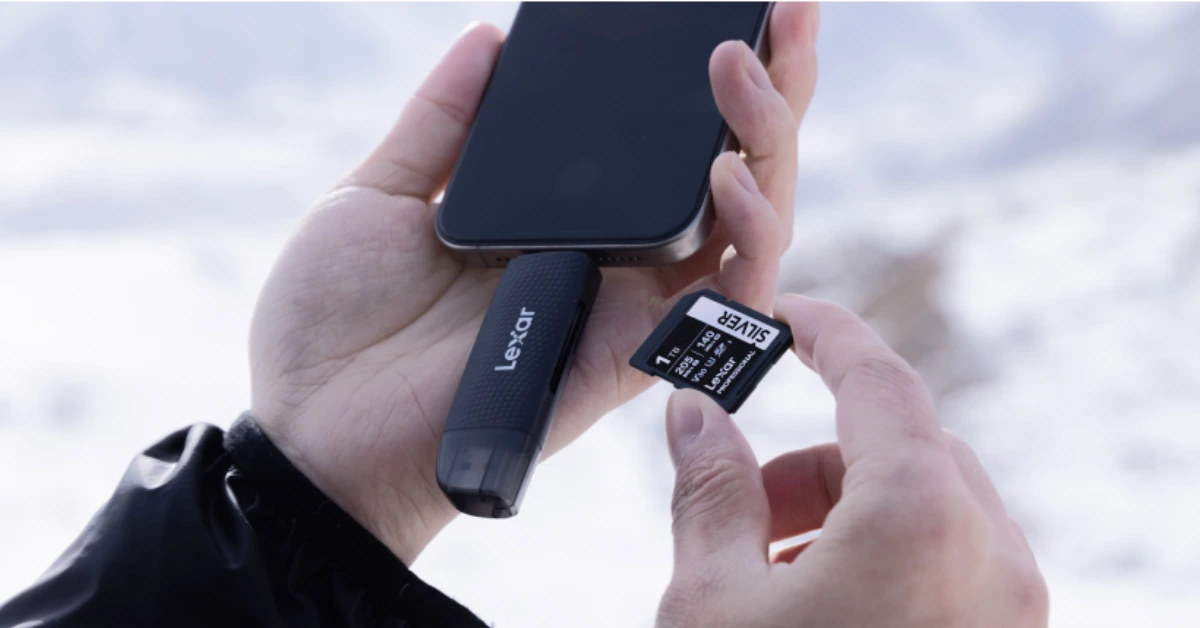


Running out of iPhone storage? An SD card reader gives you instant access to camera photos, trail cam footage, and drone videos without filling up your device. Whether you shoot with a DSLR, check hunting cameras in the field, or need quick backup storage, the right card reader changes everything.
Here’s what matters: iPhone 15 and newer models use USB-C, while older iPhones need Lightning connectors. That changes which readers work best for you. We’ll break down your options, show you what Lexar offers for cross-device compatibility, and help you pick the right solution for your workflow.
Quick Answer: What’s the Best SD Card Reader for iPhone?
For iPhone 15/16 (USB-C): Any USB-C SD card reader works, including Lexar® Dual-Slot USB-A/C Reader which handles both SD and microSD cards at speeds up to 205MB/s.
For iPhone 5-14 (Lightning): You need either a Lightning-specific reader OR a USB-C/USB-A reader plus Apple’s Lightning to USB Camera Adapter.
For cross-device use: Lexar® Dual-Slot USB-A/C Reader works across Mac, PC, iPad, and iPhone 15+ with both USB-A and USB-C connections in one compact device.
SD Card Reader vs Portable SSD vs Cloud: Which iPhone Storage Solution Wins?
Before you buy, here’s how SD card readers compare to other storage options:
| Solution | Best For | Speed | Price Point | Internet Required |
|---|---|---|---|---|
| SD Card Reader | Camera photo transfers, trail cams, one-time purchases | Up to 205MB/s with UHS-II | $15-$50 for reader + $20-$100 for cards | No |
| Portable SSD | Video editing, large file workflows, direct iPhone recording | Up to 2000MB/s | $80-$300 | No |
| Cloud Storage | Automatic backups, multi-device access | Depends on connection | $1-$10/month (recurring) | Yes |
The verdict: SD card readers make sense when you already shoot on SD cards (DSLR, drone, action cam, trail camera). They’re a one-time purchase that works anywhere. But if you need faster speeds for 4K video editing on iPhone or want to record directly to external storage, check out portable SSDs like the Lexar® Professional SL600 Portable SSD.
Do SD Card Readers Work with iPhone 15 and iPhone 16?
Yes, and it’s actually easier now. iPhone 15 and iPhone 16 switched to USB-C, which means they work with standard USB-C card readers – no special Lightning adapter needed.
What works with iPhone 15/16:
- Any USB-C SD card reader
- The Lexar® Dual-Slot USB-A/C Reader (USB-C side)
- Multi-card readers with USB-C connectors
- Even your MacBook’s card reader via cable
Just plug it in, open the Files app, and your SD card appears. No additional apps or adapters required.
For older iPhones (5-14): You need Apple’s Lightning to USB Camera Adapter ($29 from Apple) to connect USB-based card readers. Or buy a Lightning-specific card reader that plugs directly into your Lightning port.
Why You Need an SD Card Reader for iPhone (Beyond Just Storage)
Here’s what changes when you add an SD card reader to your kit:
1. Transfer DSLR and Mirrorless Photos Without a Computer
Shoot all day on your camera, pop the SD card into your reader, import to iPhone, edit in Lightroom Mobile, and post to Instagram – all without touching a laptop. For photographers who travel light, this workflow is gold.
2. Check Trail Cameras in the Field
Hunters and wildlife photographers: pull the SD card from your trail cam, plug into your iPhone right there in the woods, and see what walked past overnight. No need to haul cards back home or swap them out blind.
3. Instant Drone Footage Access
DJI and other drones write to microSD cards. With a dual-slot reader like Lexar’s, you can preview your aerial shots on iPhone immediately after flying, decide if you need another take, and share clips on the spot.
4. Backup iPhone Photos While Traveling
Running out of space mid-trip? Offload photos from iPhone to SD card for safekeeping, then clear space for more shots. One 256GB SD card costs less than upgrading to a higher-capacity iPhone.
5. Edit 4K Video Without Filling iPhone Storage
Import select clips from your camera’s SD card, edit them in LumaFusion or CapCut, export, then delete the originals. Your iPhone never holds the full multi-gigabyte files.
What to Look For in an iPhone SD Card Reader
Not all card readers are created equal. Here’s what separates the good from the junk:
Speed: UHS-II Support Matters
UHS-II card readers (like the Lexar® Dual-Slot USB-A/C Reader) hit speeds up to 205MB/s. That means a 32GB card full of RAW photos transfers in under 3 minutes instead of 10+. If you shoot high-res or 4K video, this speed difference is huge.
Dual Slots: SD + MicroSD in One Device
Cameras use full-size SD cards. Drones and action cams use microSD. A dual-slot reader handles both without carrying two devices or fiddling with adapters.
Build Quality: Metal > Plastic
Cheap plastic readers crack in bags and fail after a few months. Look for aluminum or reinforced plastic designs that can handle being tossed in a camera bag daily.
Plug-and-Play: No App Installation
Good readers work instantly with iPhone’s built-in Files app or Photos app. If a reader requires downloading sketchy third-party apps, skip it.
Cross-Device Compatibility: USB-C + USB-A
The best readers, like Lexar’s Dual-Slot model, include both USB-C and USB-A connections. That means it works with your iPhone 15+, older MacBook, Windows PC, and iPad – one reader for everything.
How Lexar’s Dual-Slot Reader Works Across All Your Devices
The Lexar® Dual-Slot USB-A/C Reader is built for photographers and creators who use multiple devices:
What Makes It Different:
- Two card slots: SD and microSD, so you handle camera cards and drone cards with one device
- Two connection types: USB-C and USB-A built into the same reader – flip between them as needed
- UHS-II speed: Up to 205MB/s read speeds for fast transfers
- Pocket-sized: Small enough to keep in your camera bag or attach to a keychain
- Broad card support: SD, SDHC, SDXC, microSD, microSDHC, microSDXC
Who It’s For:
Photographers who edit on Mac but sometimes need to transfer to Windows. Content creators who shoot on camera but post from iPhone. Anyone who bounces between devices and doesn’t want three different card readers.
iPhone Compatibility Note:
iPhone 15/16: Plug the USB-C side directly into your phone.
iPhone 5-14: Use Apple’s Lightning to USB Camera Adapter (sold separately) to connect the reader.
While this reader requires an adapter for older iPhones, that same adapter unlocks compatibility with ANY USB device – not just card readers. You can also connect USB keyboards, audio interfaces, MIDI controllers, and more.
How to Transfer Photos from SD Card to iPhone: Step-by-Step
For iPhone 15 and iPhone 16 (USB-C):
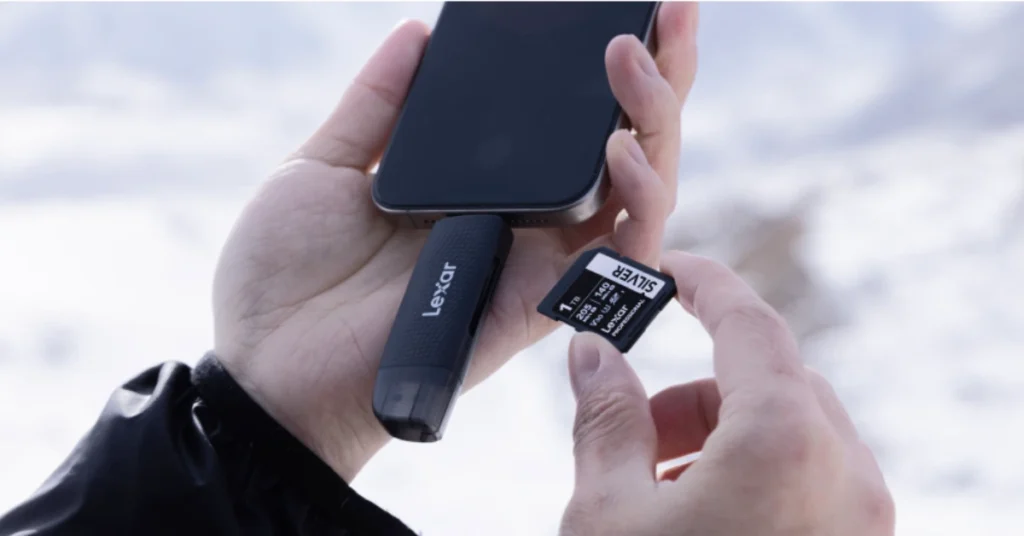
- Plug the SD card reader into your iPhone’s USB-C port – Use the USB-C side of the Lexar® Dual-Slot USB-A/C Reader
- Insert your SD or microSD card into the appropriate slot – The card clicks into place
- Open the Files app on your iPhone – It’s the blue folder icon in iOS
- Tap “Browse” at the bottom, then look for your SD card under “Locations” – It appears as “NO NAME” or the card’s label
- Navigate to your DCIM folder (or wherever your camera stores photos)
- Select the photos you want – Tap and hold one photo, then tap others to multi-select
- Tap the share button, then “Save Image” or drag them to “On My iPhone” – Photos import to your iPhone’s Photos app
- Wait for the transfer to complete – A 32GB card at UHS-II speeds takes about 2-3 minutes
- Safely eject the card – In Files app, tap the eject icon next to the card name before pulling it out
For iPhone 5-14 (Lightning):
- Connect Apple’s Lightning to USB Camera Adapter to your iPhone – This creates a USB port on your Lightning iPhone
- Plug your SD card reader into the adapter – Use the USB-A side of the Lexar® Dual-Slot USB-A/C Reader
- Insert your SD or microSD card
- iOS automatically opens the Photos app and shows “Import” tab – This is faster than using Files app
- Select photos you want to import – Or tap “Import All” in the top right
- Choose “Import” and wait for transfer – Lightning transfers are slower (USB 2.0 speeds), so expect 10-15 minutes for a 32GB card
- iOS asks “Delete or Keep” originals on card – Choose based on whether you want to clear the card
Trail Camera SD Card Workflow: From Field to iPhone
If you use trail cameras for hunting or wildlife observation, here’s the fastest way to check your cards without going home:
- Pull the SD or microSD card from your trail camera – Most trail cams use standard SD or microSD cards
- Insert into your card reader while still in the field – The Lexar® Dual-Slot USB-A/C Reader fits in a pocket
- Plug into iPhone – Works best with iPhone 15/16’s direct USB-C connection
- Open Files app and browse to the card – Trail cam photos are usually in timestamped folders
- Preview photos directly – No need to import, just tap to view full-size
- Save only the good shots to iPhone if you want – Or just view and return card to camera
Pro tip: Label your trail camera SD cards (North Ridge, Creek Crossing, etc.) so you know which camera each card came from when checking multiple sites in one trip.
Common SD Card Reader Problems and How to Fix Them
Problem: iPhone doesn’t recognize the SD card
Fix: Make sure the card is fully inserted until it clicks. Try ejecting and reinserting. If still not working, the card might be corrupted – try it in your camera or computer first to verify it works there. Also check that your iPhone’s USB-C or Lightning port is clean (debris blocks connections).
Problem: Transfer speeds are really slow
Fix: You’re likely using a UHS-I reader with UHS-II cards (or vice versa). Match your card speed to your reader speed. The Lexar® Dual-Slot USB-A/C Reader supports UHS-II speeds up to 205MB/s, but only if your SD card is also UHS-II. A UHS-I card maxes at 104MB/s regardless of reader speed.
Problem: iOS says “Cannot Use Accessory” or blocks the reader
Fix: On Lightning iPhones, this happens when battery is below 20% – iOS blocks power-hungry accessories to preserve battery. Charge your iPhone above 20%, or use Apple’s Lightning to USB 3 Camera Adapter with the extra Lightning port so you can charge while transferring.
Problem: Photos app doesn’t show Import option
Fix: Use Files app instead. Some card formats (especially if formatted on PC) don’t trigger the Photos app auto-import. Files app gives you full file system access regardless of format.
When a Portable SSD Makes More Sense Than an SD Card Reader
SD card readers are perfect for transferring camera photos, but portable SSDs shine in different scenarios:
You shoot ProRes video on iPhone 15 Pro or newer: ProRes files are massive (1GB per minute of 4K footage). iPhone 15 Pro can record directly to external SSDs, bypassing iPhone storage completely. The Lexar® Professional SL600 Portable SSD hits 2000MB/s – way faster than any SD card.
You edit video on iPhone: Editing directly from a fast SSD is smoother than importing clips to iPhone storage first. Apps like LumaFusion work better with SSD-based media.
You need expandable iPhone storage that stays connected: SD cards require a reader that sticks out. Portable SSDs can stay plugged in (or quickly reconnected) as semi-permanent expanded storage.
You transfer gigantic files regularly: If you’re moving 100GB+ of footage weekly, SSD speeds (2000MB/s) beat even the fastest SD card readers (205MB/s) by 10x.
The tradeoff: Portable SSDs cost more ($80-$300) vs SD card readers ($15-50). But if speed and capacity matter more than budget, SSDs win. Many creators use both – card reader for field transfers, SSD for heavy editing work.
Pairing Your SD Card Reader with the Right Lexar Memory Cards
Your card reader is only as fast as the memory cards you use. Here’s how to match them:
For DSLR and Mirrorless Cameras:
Lexar® Professional 1066x SDXC™ UHS-I Card SILVER Series – Up to 160MB/s read speeds, perfect for burst photography and 4K video recording. U3 and V30 rated for reliable performance.
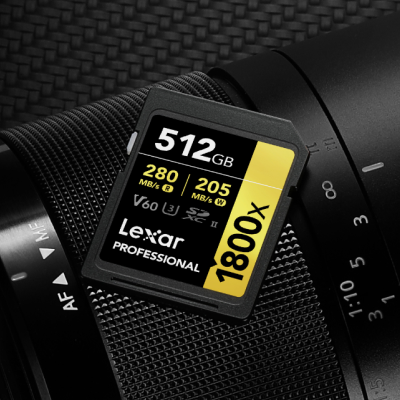
Lexar® Professional 1800x SDXC™ UHS-II Card GOLD Series – Up to 270MB/s read speeds, built for professional photographers shooting RAW continuously. Maxes out UHS-II card reader capabilities.
For Drones and Action Cameras:
Lexar® PLAY microSDXC™ UHS-I Card – Rugged, reliable, and built for high-definition video recording. Available in capacities up to 1TB for extended flight sessions.
Speed Class Decoder:
- U1 (10MB/s minimum): Basic photos, HD video
- U3 (30MB/s minimum): 4K video, burst photography
- V30, V60, V90: Video speed class – the number is minimum write speed for sustained video recording
Match your card speed to your camera’s capabilities. Shooting 4K 60fps? Get at least U3/V30. Shooting 8K? You need V60 or V90. The Lexar® Dual-Slot USB-A/C Reader handles all of these at their maximum rated speeds.
How to Organize and Manage Photos When Using SD Card Readers
1. Create a Folder System on Your SD Cards
Don’t just dump all photos into the root directory. Create folders by date or project:
- 2026-01-Wedding-Johnson
- 2026-01-Landscape-Utah
- Trail-Cam-North-Ridge
This makes finding files later much easier, especially if you use multiple cards.
2. Import Selectively, Not Everything
Don’t import 1,000 photos from a shoot. Review in the Files app first, star your favorites (using your camera’s in-camera rating), then only import those. Saves iPhone storage and makes editing faster.
3. Use the Photos App Import Feature
When you connect an SD card, Photos app shows an “Import” tab. This interface is better for batch imports than Files app. You can:
- See thumbnails of all photos
- Select multiple at once
- Choose “Import Selected” or “Import All”
- Option to delete from card after import
4. Format Cards in Your Camera, Not iPhone
After transferring, don’t format SD cards through iPhone. Always format in the camera that will shoot on that card. This prevents compatibility issues and ensures proper file structure.
5. Back Up Twice
If photos are important, don’t trust one SD card. Import to iPhone, then also back up to:
- iCloud Photos (auto-backup when on Wi-Fi)
- A portable SSD like Lexar® ARMOR 700 Portable SSD
- Your computer via AirDrop or cable
The “3-2-1 backup rule” = 3 copies, on 2 different media types, with 1 copy offsite (cloud).
The Future of iPhone Storage: USB-C Changes Everything
iPhone 15’s switch to USB-C opened up possibilities that Lightning never allowed. Here’s what’s different now:
Direct External Storage Recording
iPhone 15 Pro and newer can record ProRes video directly to external SSDs at up to 4K 60fps. This bypasses iPhone storage completely – you could theoretically shoot for hours without filling up your phone.
Faster Transfer Speeds
USB-C supports USB 3.2 speeds (10Gbps+) vs Lightning’s USB 2.0 speeds (480Mbps). That’s a 20x speed boost. Moving a 32GB card full of photos now takes 2-3 minutes instead of 30+.
Universal Accessories
The same USB-C card reader, SSD, or hub works with iPhone, iPad, MacBook, and Android devices. No more buying different accessories for different devices.
What This Means for SD Card Reader Users:
If you have iPhone 15 or newer, any quality USB-C card reader works – including the Lexar® Dual-Slot USB-A/C Reader. You’re no longer limited to Lightning-specific accessories, which means more options, better prices, and faster speeds.
If you’re still on iPhone 14 or older, Lightning to USB Camera Adapter remains your bridge to card readers. It works fine, just slower than USB-C.
Lexar Storage Solutions: Card Readers, SSDs, and Memory Cards Working Together
Lexar builds the full ecosystem for creators who need reliable storage across devices:
Card Readers: Lexar® Dual-Slot USB-A/C Reader handles SD and microSD with dual USB connectivity
Memory Cards: Lexar® Professional SILVER/GOLD Series for cameras, Lexar® PLAY cards for drones
Portable SSDs: Lexar® Professional SL600 for speed, Lexar® ARMOR 700 for durability
Internal SSDs: Lexar® NM790 for upgrading laptop/desktop storage
The advantage? Everything’s tested to work together. Your Lexar memory card + Lexar card reader are optimized for maximum transfer speeds. No compatibility guessing.
Find the Right Storage Solution
Whether you need a simple card reader for occasional photo transfers or a complete storage workflow system, Lexar has options. Browse the full lineup at the Lexar Card Reader & Accessories page to compare specs and find what fits your setup.
Ready to Transfer Photos Faster?
SD card readers solve one of iPhone’s biggest frustrations – limited storage and slow photo transfers. Whether you’re pulling trail cam footage in the woods, importing DSLR shots at a wedding, or just backing up your iPhone while traveling, the right card reader changes how you work.
For creators who use multiple devices, the Lexar® Dual-Slot USB-A/C Reader delivers speed, versatility, and reliability in one pocket-sized package. Pair it with Lexar® Professional memory cards for the fastest transfers your iPhone can handle.
Browse Lexar’s full lineup of card readers, memory cards, and portable storage solutions to build your perfect workflow.
Frequently Asked Questions About SD Card Readers for iPhone
Do I need an app to use an SD card reader with iPhone?
No. iPhone’s built-in Files app and Photos app handle SD card imports automatically. Just plug in the reader, and iOS recognizes it. Some cheaper readers claim to need special apps – avoid those, they’re often poorly made or trying to harvest your data.
Will an SD card reader work with my iPhone case on?
Usually yes, but it depends on your case. Thick cases (especially Otterbox Defender-style) may block access to the Lightning or USB-C port. You might need to temporarily remove the case, or get a USB extension cable to add clearance.
Can I transfer videos from iPhone to SD card to free up space?
Yes. Open Files app, navigate to your SD card, then drag and drop files from iPhone storage to the SD card. After confirming they copied correctly, delete the originals from iPhone. This is basically using the SD card as external storage.
How do I know if my SD card is fast enough for my needs?
Look at the speed class marking on the card:
- U1 or Class 10: 10MB/s min – fine for basic photos
- U3 or V30: 30MB/s min – handles 4K video
- V60: 60MB/s min – 4K 120fps, 8K 30fps
- V90: 90MB/s min – 8K 60fps
For fast iPhone transfers, pair any V30+ card with a UHS-II reader like Lexar® Dual-Slot USB-A/C Reader.
Why does my SD card show less space than advertised?
Two reasons: 1) File system overhead (FAT32/exFAT) takes a few GB, and 2) Manufacturers use decimal (1GB = 1,000,000,000 bytes) while computers use binary (1GB = 1,073,741,824 bytes). A 128GB card typically shows as 119GB usable. This is normal.
Can I use the same SD card reader for my iPad and iPhone?
Yes, as long as your iPad has either USB-C or you use the Lightning to USB Camera Adapter. The Lexar® Dual-Slot USB-A/C Reader works across both devices seamlessly.
What’s the difference between a card reader and a camera connection kit?
Apple’s Camera Connection Kit (now called Lightning to USB Camera Adapter) is just an adapter – it lets you connect USB devices to your Lightning iPhone. You still need a separate card reader. An all-in-one Lightning card reader combines both in one device but usually only works with iPhones, not computers. A universal card reader like Lexar’s works everywhere but needs the adapter for older iPhones.
Is it safe to delete photos directly from SD card through iPhone?
Yes, but format the card in your camera afterward. When you delete through iPhone, it removes files but doesn’t clean up the file system structure. Formatting in-camera sets everything back to optimal state for shooting.
Will using an SD card reader drain my iPhone battery?
USB-C iPhone 15/16: Minimal drain, barely noticeable.
Lightning iPhones 5-14: Yes, card readers pull power from your phone. If your battery is under 20%, iOS may block the reader to preserve power. Using Apple’s Lightning to USB 3 Camera Adapter with the charging port helps – you can charge while transferring.
Can I edit photos directly on the SD card without importing to iPhone?
Technically yes through Files app, but it’s slow and unstable. Always import files to iPhone first before editing. SD cards aren’t designed for the rapid read/write cycles that editing creates. You risk corrupting files if you edit directly on the card.