




For Gina Danza, autumn isn’t just a season. It’s a homecoming.
Gina is a professional photographer and Lexar Elite Team Member whose work centers on nature photography. Today she lives on the West Coast, but she grew up in New Jersey, the Garden State, where autumn arrived with farm stands overflowing with the harvest and hillsides turning gold and crimson. “I grew up with the seasons,” she says. “One of the fond memories I have of being home is the fall foliage.”
That connection never faded. Every October, Gina flies back east to see friends and family, and to chase the color. She has made the trip five years in a row, studying how fall foliage moves across the region and bringing back images of her chance to to “seasonally connect with nature.”
Here, Gina shares how the leaves change across the Northeast, her favorite hidden spots, and the professional photography gear she trusts to bring it all home.
How Fall Foliage Moves Through the Northeast
After years of watching the region, Gina reads autumn like a map. The color follows elevation and latitude, starting high and far north, then trickling south and toward the coast. Here’s the order she watches for:
- The Adirondacks, New York. Near Lake Placid, home of the famous 1980 “Miracle on Ice” hockey game, this is usually the first region in the country to turn. “That’s my marker,” Gina says. “If that’s going off, then it just starts to trickle everywhere else.”
- Vermont’s Northeast Kingdom and New Hampshire’s White Mountains. These turn at about the same time. In the White Mountains, Gina suggests riding the Cog Railway up Mount Washington. The summit sits above the color line, but the slopes around it blaze. Gina watches the Northeast Kingdom in late September and early October as a forecast for all of New England.
- The rest of Vermont and New Hampshire. This is when the crowds arrive, especially in Vermont.
- Maine. Western Maine follows about a week behind New Hampshire, and color reaches the coast and Acadia National Park around mid-October. “It’s all about elevation,” Gina explains. The closer you are to the coast, the later the color arrives.
- Massachusetts, Connecticut and southern New York. Boston, the Catskills, the Hudson Valley and eventually New York City peak from mid-October into early November.
Every year is different. Drought, the spring and summer weather, and even tree disease, like the beech leaf disease now affecting New England forests, shape each season. Gina has seen years where peak didn’t arrive until a week before Halloween. In 2026, the Northeast Kingdom came in bright and early, signaling a vivid season across the region.
The Art of Leaf Peeping
Gina’s trips usually begin in Boston, a city she adores. She flies in, rents a car, spends a day or two with friends who also love leaf peeping, then heads north. Her biggest lesson: leaf peeping is about exploring, not staying put.
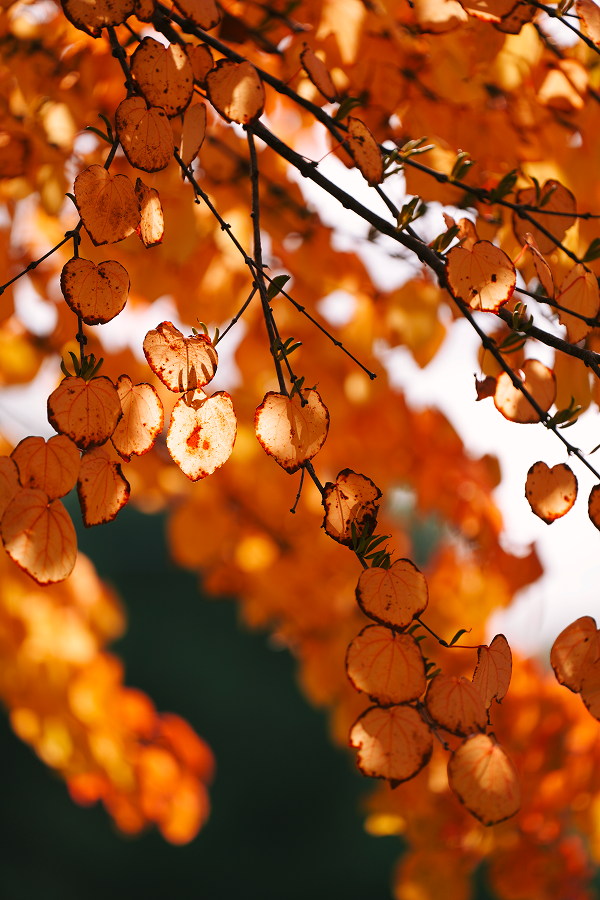
“You’re supposed to go down the dirt roads, down the back roads,” she says. “It’s not just about staying in one town and calling it a day.” If your destination is still green, she suggests driving an hour or two north to find the color.
Her other tips for planning a fall foliage trip:
- Check recent posts before you book. YouTube vlogs and Instagram posts with date stamps show when an area peaked in past years.
- Pick one region and stay a while. Gina rarely tries to cover Vermont, New Hampshire and Maine in one trip. A week or two per region is a good timeframe.
- Choose a home base with essentials. Rural Vermont can mean spotty phone service and few stores. Gina stays where she has a signal and a grocery store nearby, often in Stowe, and takes day trips from there.
- Download offline maps. If you go off-grid or camp, plan for no service and check traffic before you leave.
- Plan for early mornings. Gina is usually out before sunrise and heading home by sunset.
Flying into Boston? Gina also recommends a side trip to Salem, home of the witch trials and the filming location of Hocus Pocus, for a dose of October spirit. Just don’t count on Cape Cod or Martha’s Vineyard for big color. Coastal Massachusetts sits too low to compete with the mountains or coastal Maine.
Gina’s Favorite Fall Foliage Spots
Vermont’s Northeast Kingdom
If Gina could send every leaf peeper one place, it’s the Northeast Kingdom.
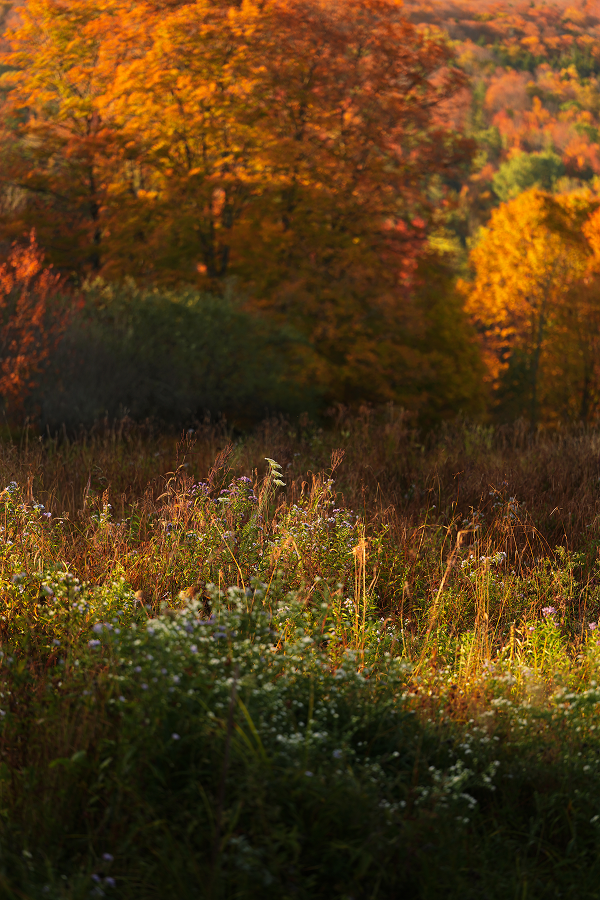
The Northeast Kingdom is a remote corner of Vermont that’s all dirt roads, lakes and deep forest, with local spots serving maple creemees along the way. Her first visit produced some of the most stunning fall foliage she has ever seen, and the region delivered again this year.
It also produced her favorite photo. One morning, while photographing bees behind her Airbnb, she looked up at a field still holding the last summer wildflowers, surrounded by orange, red and yellow. The season had turned so fast the flowers never had a chance to go to seed. She grabbed the shot with her macro lens.
“I think about apple pie when I look at that photo,” says Danza. “It just looks iconically Vermont.”
The moment taught her that a macro lens is good for far more than macro.”
The Jesup Path, Acadia National Park
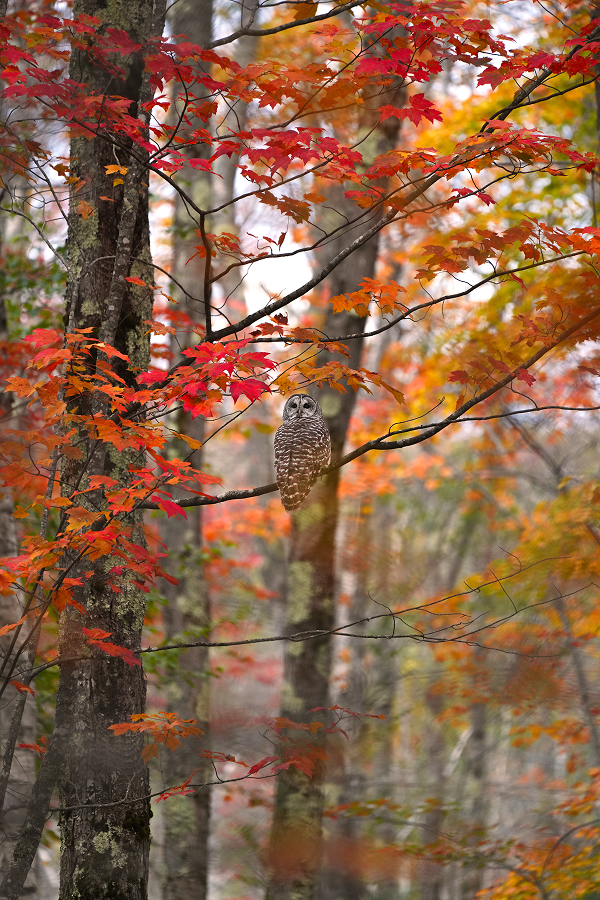
While most visitors head for Cadillac Mountain, Gina prefers this short wooden boardwalk on the park’s outskirts. She sits for hours watching the light move through the trees. It is also the only place she has ever seen barred owls, which come surprisingly close in autumn.
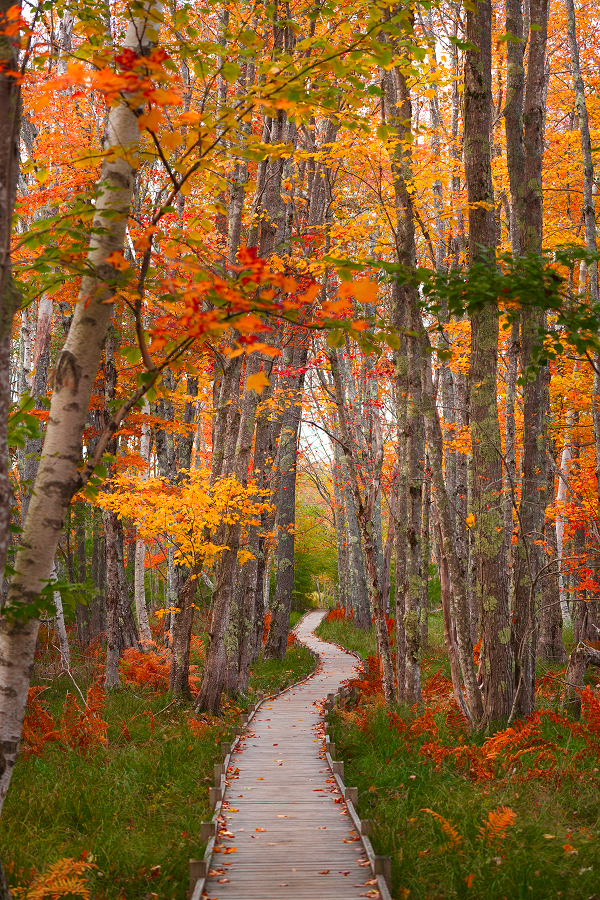
At dawn and dusk, the path becomes what Gina calls “a photographer camp,” full of fellow shooters and guided photography tours. “It is the most exciting experience because you’re able to connect with so many other people.”
She even likes Acadia just past peak, when spurts of color remain and birdlife picks up.
If you do want a summit, you can drive up Cadillac Mountain. Sunrise requires a vehicle reservation, and Gina warns they sell out in seconds. A lucky morning can reward you with a cloud inversion hanging over the color below.
Maine’s Blueberry Barrens
Gina’s hidden tip: everyone looks up at the maples, but in Maine, look down. Low-lying blueberry fields turn a brilliant red in autumn, spreading across the landscape “like a sea of red.” There’s no map to them. Just drive and watch.
As a bonus, it’s the tail end of blueberry season, so local restaurants serve fresh blueberry treats. Food lovers can go further and turn the trip into a lobster roll tour, eating their way up the coast from Portland to Acadia as the leaves turn along the route.
Back Roads Everywhere
You don’t need to summit a peak for great fall foliage. Gina loves the Adirondacks’ Hurricane Mountain, a demanding hike that leaves you surrounded by peaks and valleys of color, but she says the best shots are often on flat trails and country roads. “I’ve taken shots out of my window,” she says. That makes this one of the most accessible kinds of nature photography there is.
Gina’s Fall Foliage Photography Gear
Gina’s kit is built for long days on the road and fast sharing from the field.
Camera and lenses. She shoots on her Sony a7R V or Sony a7R VI. Her go-to lens is the Sony 100-400mm G Master, which she says is perfect for foliage. She also packs a 100mm macro lens for bees and close-up details, and it produced one of her favorite shots ever. She leaves the 200-600mm at home, though she’s considering it for owls.
Drone. Gina’s drone turned out to be a scouting tool as much as a creative one. She flies it to spot patches of red and yellow a mile or so up the road, then heads over to see them up close. Her favorite trick is fog. On misty Vermont mornings, she shoots the dewy colors before sunrise. Then, as the fog breaks, she flies above the fog line to capture sunlit, color-covered mountains. Catching the perfect moment does require some planning, and a good weather app that tracks fog and cloud ceiling is essential. Some parks have drone restrictions and require a special use permit for flight that can be applied for ahead of time.
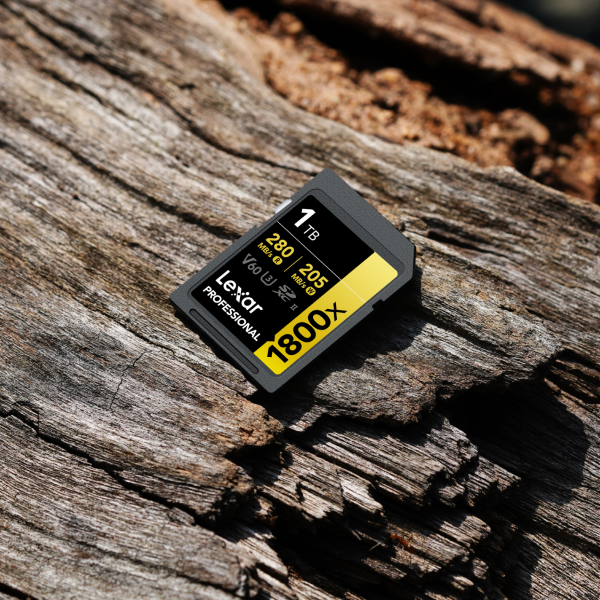
Cards for the camera. In her camera, Gina runs a 1TB Lexar Professional 1800x SDXC UHS-II Card GOLD Series. Its capacity means she can shoot all day without swapping. Her Sony a7R V’s accepts both SD cards and CFe Type A, so photographers who want even faster write speeds for long bursts can step up to a Lexar® Professional GOLD CFexpress 4.0 Type A Card.cards. She even missed a few models heading to the runway while adjusting her flash, a reminder of how little margin there is.

A microSD card for the drone. Her drone takes a 128GB Lexar SILVER Series microSD card. She keeps it small on purpose. “It gives me a little bit of a boundary,” Danza says. “Fewer files means less culling and faster posting.”
A card reader and portable SSDs. Gina wants to post the moment she shoots. Instead of a laptop, she carries a Lexar card reader that plugs into her phone or iPad. From a Vermont coffee shop on the drive back, she can review images, post one immediately, then back everything up to a portable SSD. For a traveling photographer, the best card reader is the one small enough to always be in your bag, like the Lexar Professional Workflow SD/microSD UHS-II Card Reader and the Lexar Professional Workflow CFexpress 4.0 Type A Card Reader.


A Shared Love of Autumn
For Gina, the best part of autumn in the Northeast goes beyond the color. “The best part about being up there is not only seeing the fall colors, but connecting with so many people around our shared love of autumn.”
Every year offers a new version of the season. Her bucket-list shot is the rare moment when snow-capped peaks meet fall color, which happened in Vermont just last week. “That’s an autumn miracle,” Danza observes.
If you think you’ve missed it, Gina has good news: it’s not too late. As October winds down, peak color is moving through Massachusetts, Connecticut, the Hudson Valley and New York City, and it reaches as far south as Tennessee and Arkansas into November.
The color is waiting.